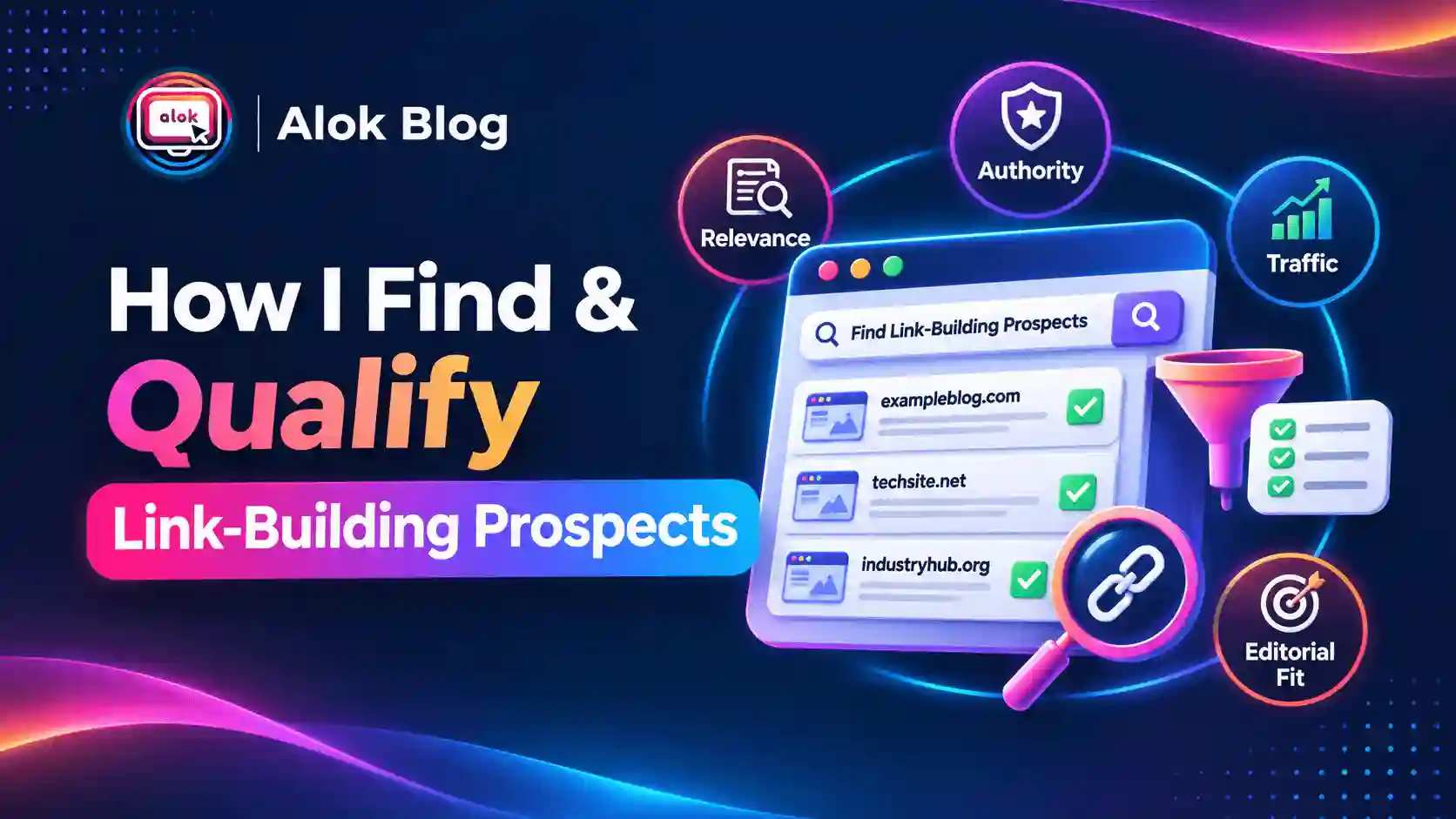
Finding websites for backlinks is not difficult. Finding relevant websites with genuine traffic, a suitable audience, and a legitimate reason to link to your page takes more work.
I regularly handle link-building prospecting and outreach, and one thing I have learned is that a large prospect list does not necessarily mean a good prospect list.
A website might have impressive authority metrics but attract traffic from irrelevant keywords. Another might have lower DA or DR but publish excellent content in the exact industry I am targeting.
That is why I qualify websites before starting outreach.
My workflow covers everything from finding niche-relevant publications and analysing traffic to avoiding duplicate domains, identifying contacts, and verifying published placements.
Here is how I approach it.
Step 1: Find Websites Relevant to the Target Page
I always start with the page I want to promote.
Before searching for websites, I understand the page’s topic, intended audience, target market, and why another publisher might reasonably reference it.
For example, if I am working on a software development service page, I would primarily look for:
- SaaS and software development publications
- Technology blogs
- Developer-focused websites
- IT and software engineering resources
- Relevant business technology publications
A general lifestyle website with a high Domain Rating would not automatically become a good prospect.
The website should have a meaningful connection to the destination page.
How I Discover Link-Building Prospects
I normally begin with niche-specific searches, competitor backlink research, and industry publications.
For a software development campaign, searches might include:
- SaaS software development blogs
- Software engineering publications
- Custom software development resources
- Technology websites accepting relevant contributions
- Developer resources covering the subject of the target page
I also review websites linking to useful competitor resources. This can reveal publications that already reference the industry.
However, I do not assume every competitor backlink is worth replicating.
My first question is whether the website fits the topic and audience, not whether it has already linked to a competitor.
Step 2: Check Organic Traffic and Ranking Keywords
Once I identify a relevant website, I investigate its organic search visibility.
I use SEO tools such as Semrush or Ahrefs to examine estimated traffic, ranking keywords, and top-performing pages.
But the total traffic number is not enough.
Traffic Must Come From Relevant Keywords
Suppose I am evaluating a software development blog.
The website shows 15,000 estimated monthly organic visits, which initially looks promising.
However, when I examine its ranking keywords, most of that traffic comes from casino-related searches.
I would reject that prospect for a software development campaign unless there were exceptional reasons to consider it.
The website might have traffic, but it does not demonstrate meaningful visibility within the niche I am targeting.
I want to see traffic coming from topics such as software engineering, SaaS, programming, application development, or relevant technology subjects.
This distinction matters because third-party organic traffic numbers are estimates. Semrush explains that its organic traffic estimates use search volume and predicted click-through rates rather than a website’s private Google Analytics data.
That is why I also inspect the keywords and pages behind those estimates.
Relevant organic visibility matters more to me than an impressive traffic number supported by unrelated queries.
Step 3: Review the Organic Traffic Graph for at Least Six Months
After checking current traffic, I review the historical trend.
I generally prefer websites that have maintained reasonably consistent organic visibility for at least six months.
A website receiving 5,000 monthly visits today might look suitable, but that number becomes less convincing if it was receiving 50,000 visits six months ago and has experienced a continuous decline.
What I Look for in the Traffic Graph
I prefer websites showing:
- Stable organic traffic over the previous six months
- Gradual growth or a consistent traffic baseline
- Normal fluctuations without unexplained collapses
- Rankings distributed across relevant pages
- Recovery after temporary declines
A small decline does not automatically mean the website is poor quality. Seasonal demand, competition, content changes, and search updates can influence traffic.
What concerns me is an unexplained, sustained loss of visibility.
A 2026 survey of 518 SEO professionals found that 63.9% considered declining organic traffic a warning sign when evaluating websites for link placements.
This is also consistent with how I work.
Six months is my initial screening period. For important or questionable prospects, I extend the review to 12 months or longer.
I prefer a website with 4,000 stable, relevant monthly visits over one showing 10,000 visits after a sudden, unexplained spike.
Step 4: Check Geographic Traffic Distribution
The next step is checking where the website’s organic traffic comes from.
If I am working on a campaign targeting the United States, I normally prefer websites receiving at least 50% of their estimated organic traffic from the US.
This is an internal prospect qualification benchmark I use, not a Google ranking requirement.
For example:
| Website | US Traffic Share | My Initial Assessment |
| Website A | 72% | Strong geographic fit |
| Website B | 55% | Meets my benchmark |
| Website C | 28% | Requires further review |
| Website D | 8% | Usually a lower priority |
Illustrative examples, not actual prospect data.
The website’s location alone is not enough. A publication operated outside the US might still attract a highly relevant American audience.
Similarly, a US-based website might receive most of its traffic from countries unrelated to my campaign.
I therefore focus on the audience and ranking keywords, not simply the company’s address or domain extension.
I also make exceptions when a publication has exceptional topical relevance or a genuinely international audience.
Step 5: Check Whether the Website Has Already Been Used
This is one of the most useful improvements we have made to our prospecting workflow.
When managing ongoing backlink campaigns, the same websites can appear repeatedly in different prospect lists.
Without a reliable tracking process, a team may contact the same publisher again without knowing that a placement already exists.
To avoid this, we developed an automated domain-checking system using Google Sheets.
How Our Automated Domain Checker Works
Our backlink sheet contains previously used websites and placement records.
The domain-checking sheet is automatically updated from that existing backlink data.
When I find a new prospect, I paste its domain into the checker.
The sheet tells me whether the website has already been used.
This helps us identify duplicate opportunities before spending time on outreach.
Why This Matters for Link-Building Campaigns
The process helps us:
- Reduce duplicate prospecting
- Avoid unnecessary repeat outreach
- Identify previously used referring domains
- Keep campaign records organised
- Focus research on new opportunities
A previously used domain is not automatically unsuitable.
Sometimes another genuinely relevant editorial reference from the same publication makes sense. However, I want to know the existing relationship and placement history before making that decision.
The checker saves time, but the final decision still requires manual review.
Step 6: Complete the Final Website Quality Check
Before contacting a publisher, I conduct a final review of the website.
This includes its editorial quality, outbound links, publishing patterns, and overall credibility.
I become cautious when I see websites publishing large volumes of unrelated guest content, using unnatural commercial anchor text, or appearing to exist mainly for link sales.
In the 2026 Editorial.Link survey, 89% of respondents identified spammy outbound links as a major warning sign, while 86.3% highlighted low-quality content.
I do not want to spend time negotiating a placement on a website that fails basic editorial checks.
I have already explained my detailed criteria in How I Evaluate Backlink Quality Beyond DA and DR.
That article covers the broader evaluation framework, including relevance, authority metrics, domain history, traffic stability, PBN concerns, and link placement quality.
For prospecting, my objective is straightforward:
Only qualified websites should move into the outreach stage.
Step 7: Find the Right Contact and Start Outreach
Once a website passes qualification, I move to outreach.
My first approach is usually through the website’s publicly listed business email or contact form.
I prefer contacting the publisher through its official channel before researching individual employees.
What I Include in My Initial Outreach
I keep the message relevant to the website.
Rather than sending a generic request asking for a backlink, I explain the potential editorial contribution or why a particular resource could be useful to its readers.
The approach depends on the opportunity.
For example, a software development publication might benefit from a technically useful article, an original research resource, or a relevant reference that improves existing content.
There should be a genuine editorial reason for the contribution.
When I Use Apollo to Find Contacts
If I do not receive a response after approximately three days, I use Apollo to identify a more relevant contact.
I generally look for people working in:
- Content marketing
- Editorial or publishing
- SEO
- Digital marketing
- Partnerships, where appropriate
Apollo’s prospect search filters allow users to find contacts using criteria such as job title, company, location, and department.
I focus on reaching the person most likely to handle the content or partnership request.
A relevant contact is more useful than sending the same message to multiple unrelated employees.
I also keep outreach respectful and avoid repeatedly contacting people who are not interested.
Step 8: Discuss the Opportunity and Finalise the Placement
When the publisher responds, I review the opportunity before moving forward.
Depending on the website and proposed contribution, this might involve adding a useful reference to an existing article, contributing original content, or arranging a clearly disclosed sponsored placement.
I discuss the proposed content, editorial requirements, publication terms, and any applicable budget.
However, an approved budget does not make a website suitable, and payment should not be used to purchase links that pass ranking credit.
Google’s link spam policies prohibit buying or selling links for ranking purposes. Google permits paid advertising and sponsorship links when they are appropriately qualified using rel=”sponsored” or rel=”nofollow”.
For legitimate editorial contributions, I want the publisher to retain editorial control and include a link only where it genuinely benefits the reader.
Link Insertion or New Article?
The choice depends on the editorial opportunity.
Contextual link insertion: An existing article contains a relevant discussion where an additional resource would genuinely help readers.
New article contribution: The publisher accepts an original, useful article that matches its editorial focus and audience.
I do not treat either format as a guarantee of SEO value.
Before proceeding, I also ensure that the proposed destination page is relevant and the anchor text reads naturally.
Step 9: Verify the Published Link and Update Our Records
My work does not finish when a publisher confirms that an article is live.
I review the published page and check whether the final placement meets the agreed editorial requirements.
My Post-Publication Checks
I verify:
- The published URL loads correctly
- The article is relevant and readable
- The destination URL is correct
- The anchor text is natural
- The link appears within appropriate context
- The link attributes reflect the nature of the placement
- The content has not been substantially changed in a misleading way
I then update our backlink sheet with the published URL, destination, relevant placement details, and status.
That record also feeds our existing domain-checking workflow, helping the team identify previously used websites during future prospecting.
For ongoing campaigns, I consider periodic checks useful for identifying removed or changed placements.
A link reported as published is not necessarily a link that remains live six months later.
My Link-Building Prospect Qualification Checklist
Here is how I summarise the process before approving a new opportunity.
| Check | My Qualification Approach |
| Niche relevance | Relevant to the target page and industry |
| Organic traffic | Genuine visibility from relevant keywords |
| Traffic trend | Reasonably stable for at least six months |
| Geographic fit | Prefer 50% or more US traffic for US campaigns |
| Domain history | No concerning or unexplained changes |
| Website quality | Legitimate editorial content and audience |
| Domain uniqueness | Checked against our backlink records |
| Outreach contact | Appropriate publisher or marketing contact |
| Placement | Relevant, transparent, and editorially justified |
| Verification | Published URL and link attributes checked |
Not every website needs to satisfy the same numerical thresholds.
What matters is having a consistent process that helps distinguish promising opportunities from websites that are unlikely to provide genuine value.
Final Thoughts: Better Prospecting Leads to Better Outreach
I do not believe link-building success should be measured only by how many websites we contact or how many placements are reported.
I would rather work with a smaller list of relevant, qualified websites than spend time contacting hundreds of unrelated publications.
For me, the process starts with niche relevance, genuine organic visibility, traffic consistency, geographic fit, and domain uniqueness.
Only then do I move to contact discovery, outreach, and placement discussions.
Our automated Google Sheets checker helps reduce repetitive work, but the most important part of the process remains human judgment.
That is the approach I follow in my broader link-building and outreach work: research carefully, contact relevant publishers, prioritise editorial value, and verify what gets published.