When I evaluate a website for a backlink, DA and DR are never my only selection criteria.
They are useful metrics for an initial check, but a high Domain Authority or Domain Rating does not automatically mean a website is a good backlink opportunity.
I regularly evaluate domains as part of my link building and outreach work. I have seen websites with impressive authority metrics but very little organic visibility, declining traffic, irrelevant content, or publishing patterns that clearly suggest they exist mainly to sell links.
I have also seen lower-DR websites with strong topical relevance, genuine organic traffic, a stable search presence, and a real audience. In many cases, I would choose the second website.
This is also consistent with how the metrics themselves are intended to be used. Ahrefs defines Domain Rating as a measure of backlink profile strength, not as a Google ranking factor. In a 2025 study covering one million SERPs, Ahrefs found a 0.131 correlation between DR and rankings, which it described as a small positive correlation rather than a definitive relationship. Read Ahrefs’ 2026 Domain Rating analysis
My approach is simple:
DA and DR can help me investigate a website. They do not approve the backlink.
The Backlink Quality Signals I Actually Evaluate
I look at several signals together before I decide whether a website is worth approaching.
1. Topical Relevance Comes First
The first thing I check is relevance.
If I am building backlinks for an education website, I would prefer links from websites covering education, careers, technology, professional development, business, or closely related subjects.
A high-DR website publishing unrelated articles across dozens of industries is much less interesting to me.
I evaluate relevance at two levels:
Domain-level relevance
Does the website regularly publish content related to the industry I am working in?
Page-level relevance
Does the specific article linking to my page have a genuine contextual reason to reference it?
Page relevance is especially important. Even a broadly relevant website can provide a weak backlink if the placement itself has nothing to do with the destination page.
My rule is simple:
The backlink should make sense even if SEO did not exist.
If a genuine reader can understand why the link is there, that is usually a much better starting point.
2. I Check Real Organic Visibility
After relevance, I look at the website’s organic search performance.
Traffic is important, but I do not simply look at the large number displayed at the top of an SEO tool and make a decision.
I review:
- estimated organic traffic;
- ranking keywords;
- pages generating that traffic;
- keyword relevance;
- country-level traffic;
- whether important pages are indexed;
- whether traffic is distributed across the site or dependent on only one or two pages.
A website receiving 3,000 to 5,000 relevant organic visits per month can be a strong opportunity even if its DA or DR looks modest.
For example:
| Prospect | DR | Organic Traffic | Relevance | Initial View |
| Website A | 72 | 300 | Low | Weak |
| Website B | 34 | 4,500 | High | Stronger |
| Website C | 48 | 6,000 | High | Strong |
| Website D | 65 | 900 | Low | Needs investigation |
I would usually spend more time investigating Website B than Website A.
Even Semrush’s own Authority Score now incorporates organic traffic and spam-related signals alongside backlink strength. It specifically checks for patterns such as high backlink counts with little organic traffic, unusual dofollow ratios, shared IP networks, and identical backlink profiles. See how Semrush calculates Authority Score
That reinforces an important point: authority cannot be evaluated properly from backlinks alone.
3. I Review the Traffic Graph for at Least 12 Months
This is one of the most important checks in my current backlink qualification process.
A website might show 10,000 organic visits today, but that number does not tell me how healthy the domain has been over time.
I normally review at least 12 months of organic traffic history.
I prefer websites that show sustained search visibility, relatively stable performance, or gradual growth.
What I like to see
A healthy traffic graph usually has characteristics such as:
- consistent organic visibility across the year;
- normal increases and decreases rather than repeated collapses;
- a relatively stable baseline;
- gradual growth over time;
- recovery after temporary declines;
- traffic supported by several ranking pages and topics.
The graph does not need to move upward every month.
Search demand changes. Seasonal businesses fluctuate. Google updates can affect rankings. Content is added and removed.
A moderate decrease is not automatically a reason to reject a domain.
What matters is the overall pattern.
What makes me investigate further
I become cautious when I see:
- traffic falling from 50K to 3K and staying there;
- repeated sharp rises and collapses;
- a major loss of ranking keywords;
- traffic dropping at the same time the website starts publishing unrelated guest content;
- sudden traffic growth caused by a handful of irrelevant keywords;
- almost no recovery after a prolonged decline.
Consider these examples:
| Website | Current Traffic | 12-Month Pattern | My View |
| Site A | 5,000 | Stable between 4K and 6K | Strong |
| Site B | 5,000 | Declined from 50K | Investigate |
| Site C | 3,500 | Grew steadily from 1K | Strong potential |
| Site D | 8,000 | Repeated sharp spikes and drops | Higher risk |
This is why I consider the traffic graph more useful than the current traffic number alone.
A site with 4K stable traffic for a year can give me more confidence than a site showing 20K today after an unexplained spike three weeks ago.
4. I Check Where the Traffic Comes From
Traffic quantity is only part of the picture. Geographic relevance matters too.
If I am building backlinks to improve visibility in the United States, I want to understand whether the referring website actually has meaningful US visibility.
I check the site’s country-level organic traffic and rankings rather than relying only on its company address or domain extension.
For example, if two equally relevant websites are available and one receives meaningful US search traffic while the other receives almost all of its traffic from a market unrelated to the campaign, I will usually prioritise the first.
This is not an absolute rule.
A respected international education publication can still be highly valuable for a US-focused education brand.
The principle is audience alignment, not blindly requiring every backlink to come from a US-owned website.
5. I Review Site History, Not Just Domain Age
Domain age is another useful signal, but it needs context.
I generally prefer established websites with a consistent history, but an old domain is not automatically trustworthy.
An expired 15-year-old domain can be repurposed into a poor-quality publishing site. A genuine three-year-old industry publication may be a much better backlink source.
I investigate:
- historical topic changes;
- expired-domain reuse;
- previous versions of the website;
- major traffic changes;
- changes in publishing behaviour;
- unusual increases in outbound commercial content.
Google specifically identifies expired domain abuse as repurposing expired domains primarily to manipulate search rankings through low-value content. Review Google’s current spam policies
So instead of asking only, “How old is this domain?”, I ask:
Has this website had a genuine and consistent purpose over time?
6. I Avoid Websites That Exist Mainly to Sell Links
This is one of the fastest ways a high-metric prospect can move to my rejection list.
A legitimate publication may publish sponsored or contributed content. That alone does not make the site poor quality.
The problem starts when most of the website appears to exist for backlink placement.
Common warning signs include:
- unrelated industries published side by side;
- excessive guest posts;
- obvious commercial anchor text throughout the site;
- large numbers of link-insertion articles;
- thin content created around backlinks;
- very high outbound-link frequency;
- casino, loans, crypto, health, SaaS, education, home improvement, and unrelated topics mixed without a clear audience;
- almost every page appearing monetised through SEO placements.
Google’s current spam policies define creating links primarily to manipulate rankings as link spam. This includes paid links that pass ranking credit, excessive link exchanges, automated link creation, and certain optimised links in paid or distributed content. Google says paid advertising or sponsorship links should be appropriately qualified with rel=”sponsored” or rel=”nofollow”. Read Google’s link spam guidance
If the entire website looks like a marketplace for SEO links, a high DR does not change my decision.
7. I Stay Away From PBN-Style Networks
I do not intentionally build links from private blog networks.
Sometimes a network is obvious. Sometimes it requires deeper investigation.
I look for patterns such as:
- identical or nearly identical templates;
- multiple domains publishing the same types of articles;
- unnatural cross-linking;
- overlapping backlink profiles;
- thin or mass-produced content;
- websites with no identifiable audience or business purpose;
- groups of sites hosted on related infrastructure.
Semrush specifically identifies multiple referring domains sharing the same IP or IP network, and domains with nearly identical backlink profiles, as potential indicators of unnatural link manipulation or PBN activity.
I would rather build fewer links from genuine websites than increase volume through networks whose primary purpose is manipulating search signals.
8. I Look at Editorial Quality and Outbound Linking Behaviour
Before approving a website, I actually read its content.
That sounds obvious, but it is easy to overlook when link prospecting becomes spreadsheet-driven.
I ask:
- Is the content written for real readers?
- Are authors identifiable?
- Are articles useful and well edited?
- Are external sources cited naturally?
- Are links being inserted wherever someone is willing to pay?
- Does the publication have a recognisable editorial focus?
I also open several recent articles and inspect the outbound links.
If every article contains multiple commercial links with keyword-heavy anchors, I become cautious.
The individual backlink I am considering may look fine, but the link neighbourhood of the website matters to my assessment.
9. I Keep Anchor Text Natural
Once I approve a website, I still need to evaluate how the backlink will be placed.
I do not try to force an exact-match keyword into every backlink.
Google recommends anchor text that is descriptive, concise, relevant, and natural. Its guidance also specifically warns against forcing keywords into anchor text. Read Google’s anchor text best practices
Depending on the context, I may use:
- branded anchors;
- partial-match anchors;
- contextual phrases;
- page or product names;
- URLs;
- exact-match anchors when they genuinely fit.
My priority is that the anchor reads naturally within the sentence.
If the sentence looks as though it was rewritten purely to insert an SEO keyword, the placement probably needs improvement.
10. The Destination Page Must Fit the Placement
A good website does not automatically create a good backlink.
The page receiving the backlink also matters.
Before finalising a placement, I ask:
Why should the publisher link to this exact page?
A research article might naturally cite a study or report.
A career article might reference a useful educational guide.
A product comparison may naturally point to a relevant product page.
But forcing a commercial landing page into an unrelated informational article simply because that page needs backlinks can weaken the placement.
This is why my link-building approach evaluates the referring domain, linking page, anchor, destination, and audience together.
My Backlink Quality Priority Matrix
If I had to summarise my qualification process, I would weight the signals roughly like this:
| Signal | Priority |
| Topical relevance | Very High |
| Linking-page relevance | Very High |
| Genuine organic visibility | Very High |
| 12-month traffic stability | Very High |
| Editorial quality | Very High |
| Target-country audience fit | High |
| Site history and consistency | High |
| Outbound-link behaviour | High |
| Destination-page fit | High |
| DA/DR | Secondary |
| Domain age alone | Secondary |
DA and DR are still useful.
I simply want them to support the investigation rather than control it.
A Simple Example of How I Make the Decision
Suppose I have these two prospects:
Prospect A
DR: 71
Organic traffic: 700
Traffic history: Down from 18K over the previous year
Relevance: Low
Publishing pattern: Large number of unrelated guest posts
Target-country traffic: Weak
Decision: I would probably reject it.
Prospect B
DR: 36
Organic traffic: 4,800
Traffic history: Stable between approximately 4K and 6K for the past year
Relevance: Strong
Publishing pattern: Focused and editorially consistent
Target-country traffic: Strong
Decision: I would go ahead with this.
For me, Prospect B provides much stronger evidence of being a genuine, relevant website with an active search audience.
The DR difference does not change that.
How I Apply This Approach in My Work With Great Learning
I use this type of evaluation when qualifying backlink opportunities in my work with Great Learning.
The goal is not simply to increase the number of referring domains. I want to build relevant references from websites that have genuine audiences, sustainable search visibility, appropriate geographic reach, and strong contextual alignment.
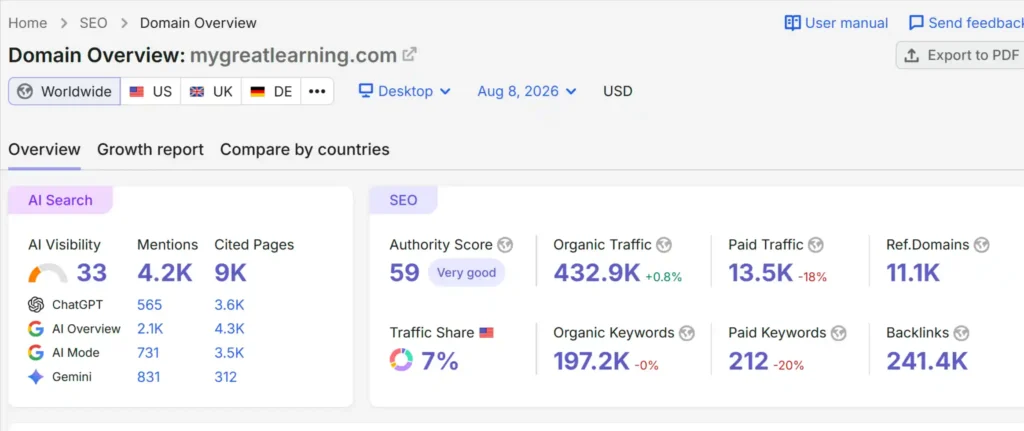
The Semrush snapshot I reviewed for Great Learning on August 8, 2026 showed approximately:
| Metric | Semrush Snapshot |
| Authority Score | 59 |
| Organic Traffic | 433K |
| Organic Keywords | 197.2K |
| Referring Domains | 11.1K |
| Backlinks | 241.2K |
| AI Visibility | 33 |
| AI Mentions | 4.2K |
| Cited Pages | 9K |
I also look beyond the current traffic number.
In the 12-month traffic graph, Great Learning maintains substantial organic visibility across the observed period, with normal fluctuations and stronger growth later in the year.
That is the type of pattern I want to investigate when evaluating a prospective referring domain. Sustained visibility gives me more confidence than a website whose traffic appears high today but has recently collapsed or increased without a clear reason.
Great Learning also has measurable visibility across ChatGPT, Google AI surfaces, Gemini, and other AI-assisted search environments in the Semrush data provided.
However, I do not claim that an individual backlink directly caused a specific SERP ranking, AI citation, AEO result, or GEO mention.
SEO does not work that cleanly.
Links are one part of a much broader authority and discovery system involving content quality, technical accessibility, entities, relevance, brand signals, citations, and many other factors.
That is also why my approach to AI Search Optimization, AEO and GEO focuses on observable evidence rather than promising that one tactic will produce AI visibility.
Backlink Red Flags That Usually Make Me Walk Away
I normally investigate further or reject a prospect when I see several of these signals together:
- very high DA or DR with almost no organic traffic;
- a major 12-month traffic collapse;
- obvious PBN characteristics;
- large amounts of unrelated guest content;
- excessive commercial outbound links;
- poor editorial quality;
- irrelevant geographic traffic;
- suspicious domain-history changes;
- aggressive exact-match anchors;
- ranking visibility dependent on only a few irrelevant pages;
- a site that appears to exist primarily for selling links.
One red flag does not always mean the website is bad.
I look for patterns.
DA and DR Are Supporting Metrics, Not My Decision
I still check DA, DR, Authority Score, referring domains, and similar metrics.
They are useful for benchmarking and initial prospect screening.
But backlink quality requires manual judgment.
I would rather earn a contextual backlink from a highly relevant DR 30 to 40 website with 3K to 5K genuine, stable organic traffic than take a link from an unrelated DR 70 website whose rankings have collapsed and whose content appears to exist mainly for paid placements.
My final question is not:
“How high is the DR?”
It is:
“Does this website, this page, this audience, and this backlink make sense together?”
If the answer is yes, the link is worth investigating.
If the answer is no, an impressive authority score is not enough to change my mind.
Test a contextual placement
Use the free Backlink Placement Analyzer to compare a source article, destination page, and preferred anchor using this evidence-led approach.